
Copy & Creative Management
From campaign brief to broadcast-ready copy — in minutes, not days.
Manage copy across campaigns, stations and schedules. AI generates broadcast-ready audio ad scripts directly from the campaign brief — drawing on targeting parameters and CRM-held brand attributes to produce creative aligned with advertiser identity, including background music and sound effects. From copy approval through rotation scheduling, closing the last manual gap between brief and air.
Campaign brief in. Broadcast-ready copy out.
For two decades the commercial workflow has been quietly stalled at the same point: plans get built in minutes, but the creative to fill them still takes days. Briefs go to a production house, scripts come back, revisions cycle, voiceovers are booked, audio gets cut, files are returned, and the campaign that was sold last Tuesday is finally on air the week after. adserve closes that gap with AI-native creative generation — the last manual workflow in the journey from brief to broadcast, replaced.
Brief-to-script AI
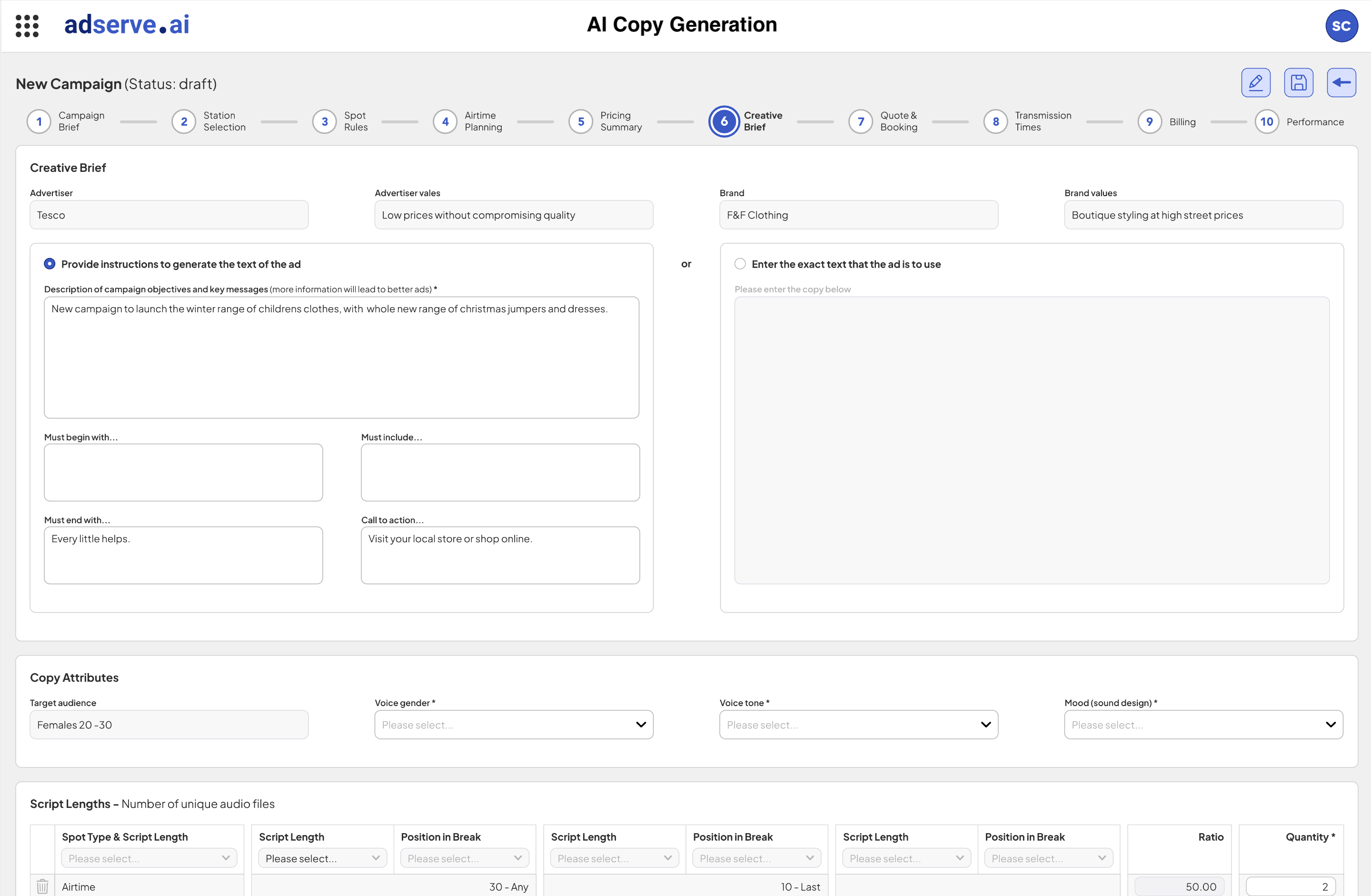
The campaign brief that powers planning is the same brief that drives creative. adserve's AI takes targeting, audience profile, advertiser identity, brand attributes held in CRM and the campaign's commercial intent — and produces broadcast-ready audio scripts directly. No separate creative brief, no agency back-and-forth, no producer waiting on copy approval before they can book the studio.
What used to be a multi-day production cycle becomes minutes. The script is not a generic stock pitch — it is grounded in the same commercial context that built the plan, so it speaks to the right audience in the right tone for the right station.
Audio production elements
A script is not yet a radio ad. adserve completes the production cycle natively: AI-generated voiceovers, background music beds, sound effects and stings are layered into the script as broadcast-ready audio, with the pacing, tone and brand feel the campaign requires. Beds reflect the genre and audience of the station the spot is destined for; voices match the advertiser's brand identity.
For broadcasters and agencies that prefer to keep human voice talent, the same workflow exports a fully-produced script ready for studio. AI does not replace the creative team — it removes the manufacturing friction between idea and air.
Version management
One advertiser, one campaign, ten variants — by daypart, by station genre, by audience segment, by campaign phase. The volume of creative variants modern audio strategies demand has historically been the reason most broadcasters quietly run one or two generic scripts across every break. adserve generates the variants automatically against the same brand attributes, then tracks the entire lifecycle: which version is approved, which is on air on which station, which is in revision, which has been retired.
Trafficking picks up the right variant for each spot automatically based on rotation policy and version targeting — closing the loop between creative intent and what actually broadcasts.
Brand consistency
The risk that has held many brands back from AI-generated audio is consistency — that variant five sounds like a different company from variant one, or that a generated script breaks a regulatory or brand rule that should never have been broken. adserve solves this by treating brand identity as structured data held in CRM: tone of voice, mandatory elements, prohibited claims, audio identity, compliance lines.
Every script the AI generates is bounded by those attributes by default. The output stays on brand, every time — not because a human reviewed it, but because the system couldn't have produced anything else.
Organised. Approved. On air.
Copy approval workflows
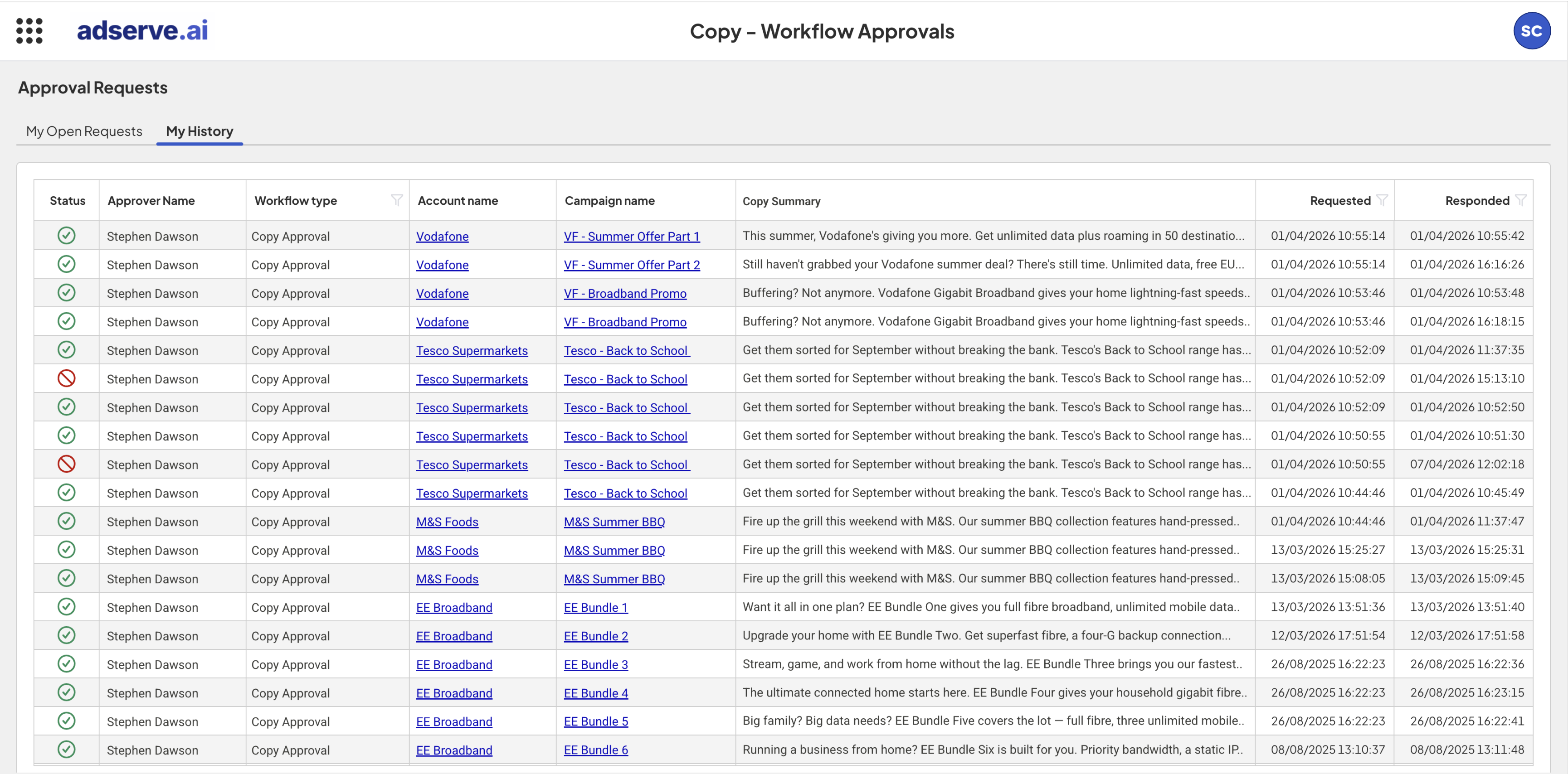
The single most common reason a campaign misses its on-air date is approvals stalled in email. Advertiser sign-off is overdue, compliance review hasn't happened, final QA didn't reach the right person. adserve replaces email-tag with a governed multi-step workflow: each approver gets the right version, on the right device, with the right context, and the approval is logged with timestamp and identity.
Mobile sign-off works the same way as desktop. The audit trail is complete and SOX-friendly. Campaigns hit air on time because nothing is sitting in someone's inbox.
Rotation scheduling
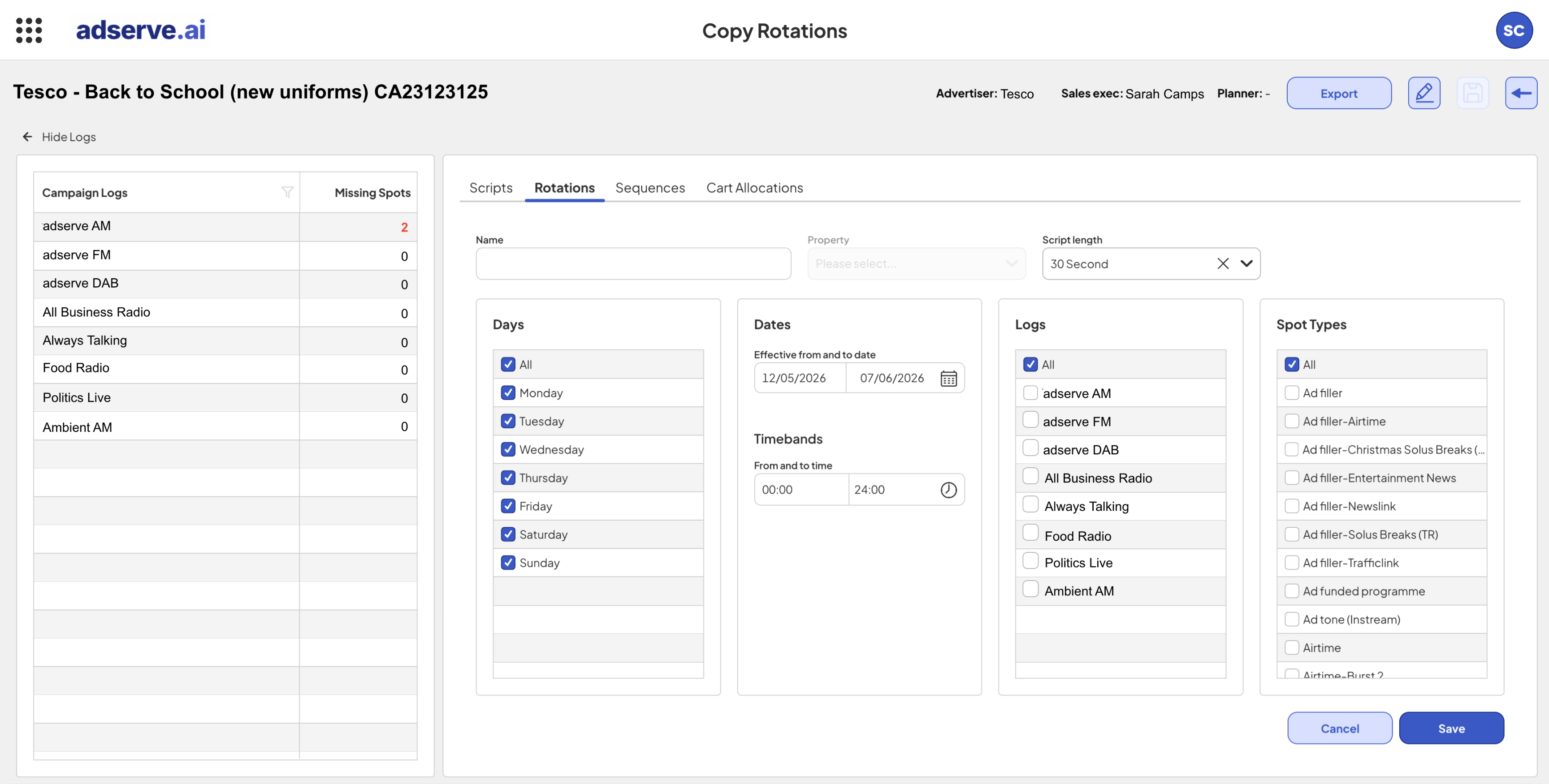
The same creative running every spot in every break is the fastest way to wear out an audience — and the easiest pattern for a traffic team to fall back into when scheduling rotation by hand. adserve exposes rotation as a first-class commercial decision: by daypart, by week, by frequency, by creative A/B test, by campaign phase.
Schedules go in once; trafficking applies them automatically to every relevant spot across every station in the group. Performance feedback from delivery reporting flows back into rotation decisions for the next campaign — turning what used to be a manual, repetitive task into a continuously learning system.
Connected to the platform.
Order Management System
Briefs captured in Campaign Manager become the input to AI copy generation. Brand attributes from CRM inform the creative output automatically.
Explore Order Management System DownstreamTrafficking & broadcast ops
Approved creative flows into Trafficking, where rotation rules and version targeting determine which spot airs where, when.
Explore TraffickingReady to close the gap between brief and air?
From campaign brief to broadcast-ready copy in minutes, not days. Get in touch to arrange a demo.